
Colour rather than form
Leave green, planned leave hatched, sick red, release yellow. The span colours in as you drag and the account recalculates at once. The eraser takes a marking back just as quickly.
The leave chapterLeave, illness and release are drawn across the calendar rather than typed into forms — for individuals as much as for whole groups. Requests are made digitally, decided with one click, and the time account recalculates at once.
Entry works without forms. Pick a tool, drag across the days — done.
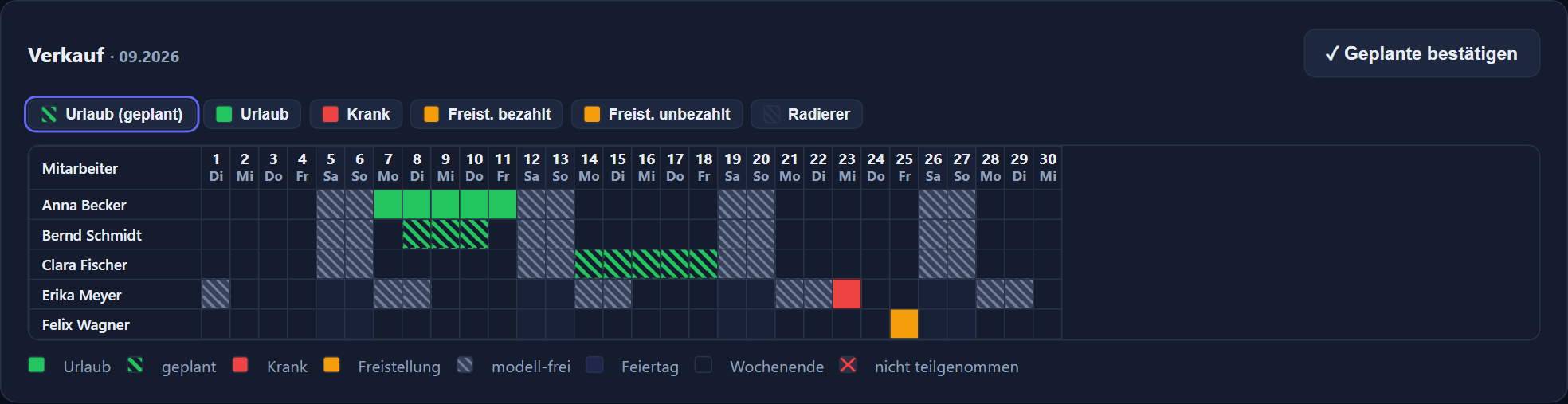
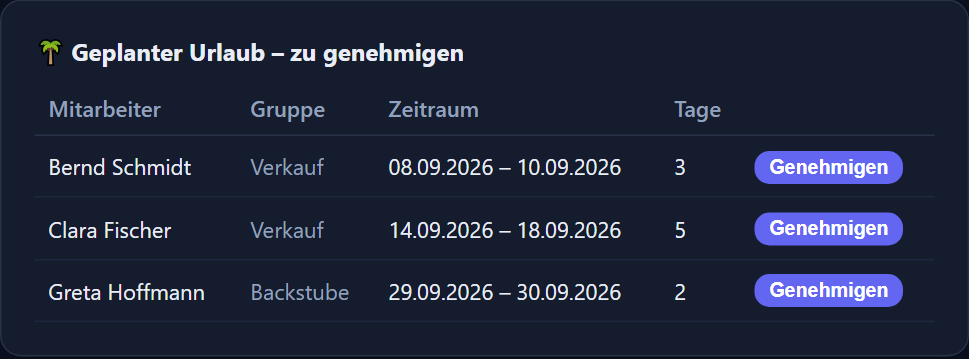
Leave green, planned leave hatched, sick red, release yellow. The span colours in as you drag and the account recalculates at once. The eraser takes a marking back just as quickly.
The leave chapterThe planning view lays the whole group on top of one another: one row per person, one column per day. Two sales assistants in the same week stand out before the second request is decided — and planning happens in the view itself, not in lists.
One holiday account per employee with entitlement, carry-over and remainder. The entitlement is dated: if weekly hours change mid-year, how the entitlement came about stays traceable.
The slip on the desk and the question in passing both go. Until a decision is made, the time account stays untouched.
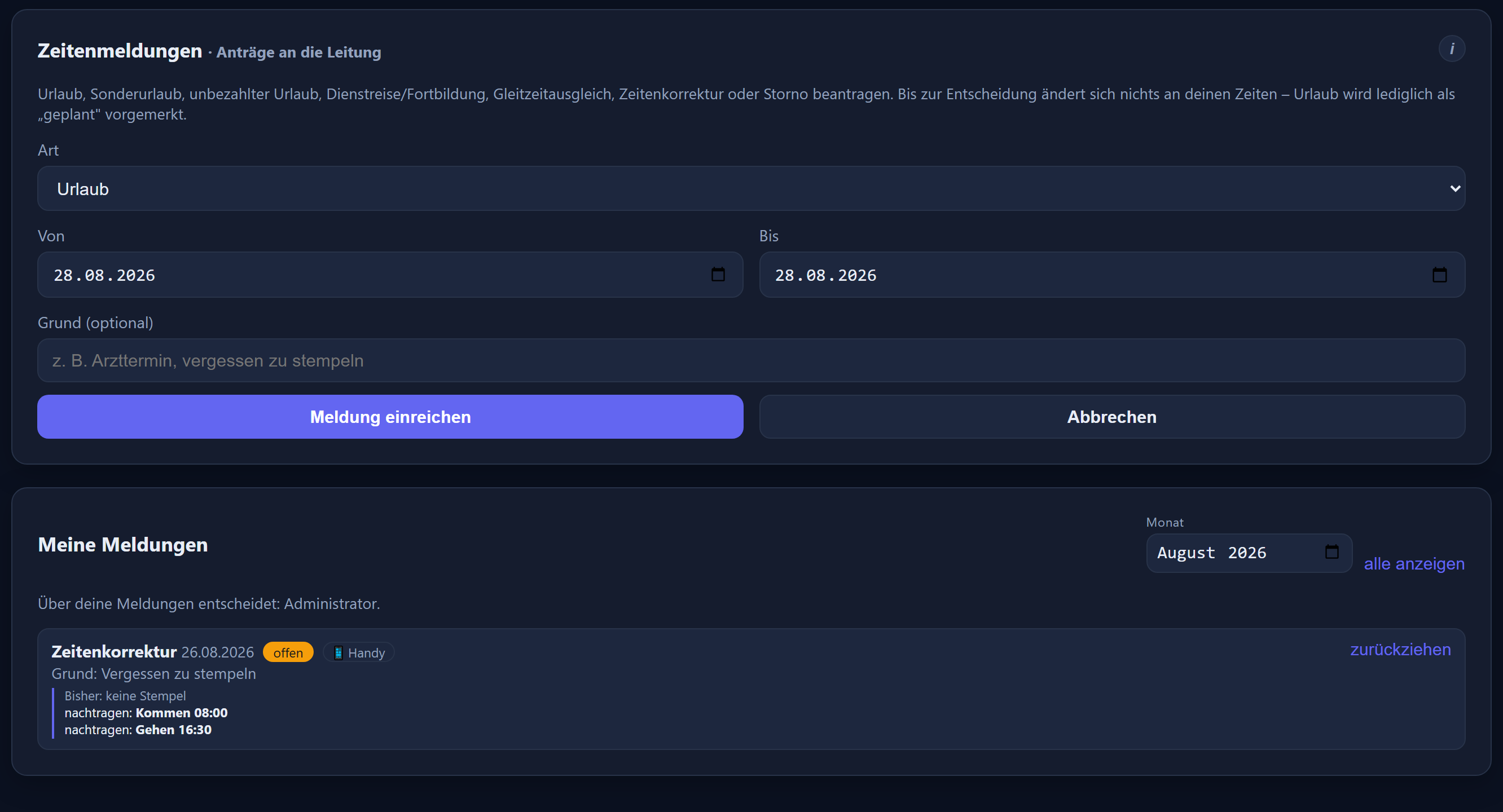
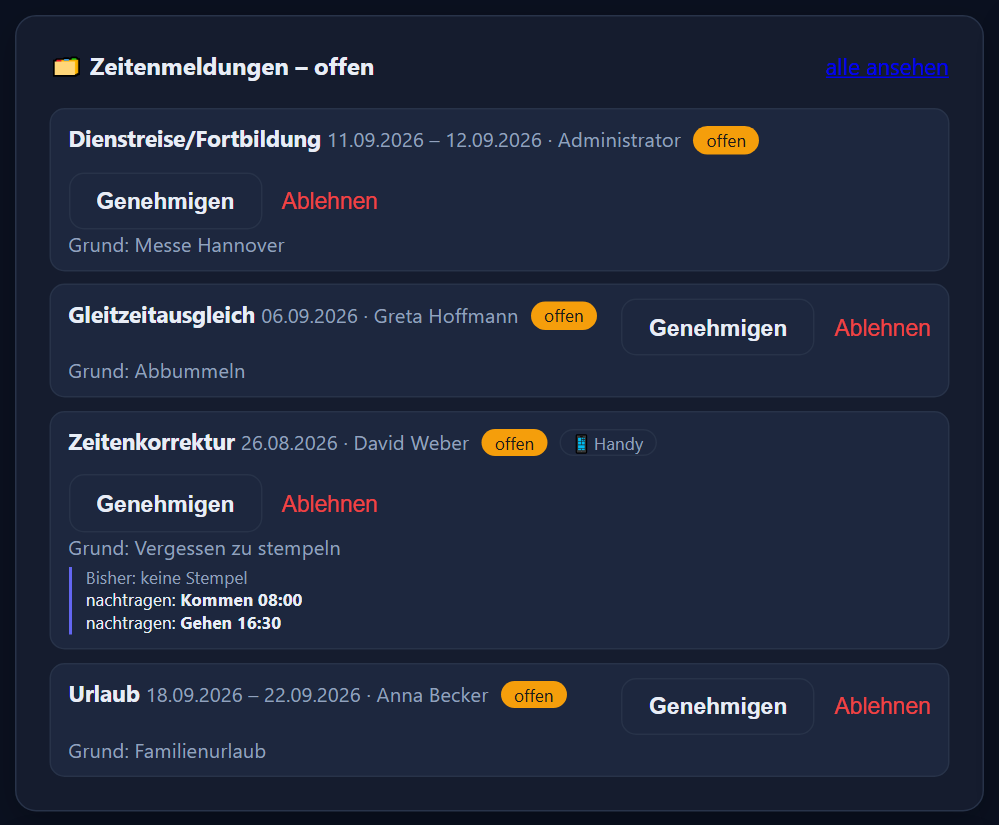
Leave, special leave, unpaid leave, business travel, training, flexitime compensation, time correction and the cancellation of an entered day. Common reasons are offered for selection; free text stays possible.
The named line manager decides; without one, management does, otherwise the administrators. A deputy can be stored per group so nothing stalls during a holiday.
Not even a department head — for your own request the button is simply not there.
Before approving a time correction the server checks whether the day has been edited since. If so, it declines rather than overwriting a newer change.
A message to those responsible on arrival, a message to the employee on the decision. Without a stored address it all simply appears in the web and mobile app.
Who decided what and when is in the change log — with person, time and reason.
Anyone who wants their leave in their mail program should not have to enter it twice.
With the calendar connection set up, every full-day absence is entered as an appointment in the personal calendar — on a computer, on a phone or in webmail.
Planned leave appears as a tentative appointment. On approval the same appointment is set to confirmed; if the absence is removed, the appointment goes too.
The exchange runs over CalDAV. That lets the time tracking work with a whole range of mail and groupware servers, self-hosted ones included.
The connection is set up for each employee individually, with their own password stored encrypted.
Graphically, with no form. In the calendar bar you pick the tool — leave, planned leave, sick, paid or unpaid release — and drag it across the days. The span colours in immediately and the account recalculates at once. The eraser takes a marking back just as quickly.
Yes, that is what the planning view is for: one row per person, one column per day, the whole group side by side. Leave, planned requests and sick days lie on top of one another in colour, so bottlenecks stand out — two sales assistants in the same week are visible before the second request is approved.
Yes, at a computer or on a phone. Requested leave appears immediately as „geplant“ (planned) in the grid, so the department sees early who would like time off. Nothing changes on the time account until a decision is made.
Special leave, unpaid leave, business travel, training, flexitime compensation, the correction of a forgotten clock-in, and the cancellation of an entered day. Common reasons are offered for selection — forgot to clock, wrong time, clocked twice, terminal unreachable, doctor's appointment, business errand — and free text stays possible.
The person's named line manager. If none is stored, management decides, otherwise the administrators. Open requests appear as a figure and a card on the dashboard and are approved there, or declined with a reason.
No, not even a department head — the button simply is not there for your own request. A deputy can be stored per group so that nothing stalls while the manager is away.
Before a time correction is approved, the server checks whether the day has been edited in the meantime. If it has, the approval is declined rather than pushing a stale correction over a newer change.
If you want, the system sends email in both directions: to those responsible when a request arrives, and to the employee once it is decided. Without a stored address the decision simply appears in the web and mobile app — nobody needs a mailbox for it.
Yes, through CalDAV — the open calendar standard. With the connection to your mail server set up, every full-day absence is entered as an appointment in the personal calendar: planned leave as a tentative appointment, switched to confirmed on approval, and deleted again if the absence is removed. The connection is voluntary and set up per employee with their own, encrypted password.
Each employee has a holiday account with entitlement, carry-over and remainder. The entitlement is dated, so a change mid-year — a change in weekly hours, for instance — stays traceable.
Everything in detail is in the chapters leave and absences and requests of the feature reference.
A spreadsheet, a paper form, a word in passing? Tell us how it is handled today and how many people are involved — then we will show the route on your own case.
Until it is ready, please write to us directly — you will hear back just as quickly. The button below opens your mail programme with a prepared draft that already lists the details we need in order to quote.
Or simply write to info@itn-network.de. Please do not send us credentials or any of your employees' time records — figures are enough for a quote.