
Recording working hours: what applies — and what does not
Two false statements circulate on this subject: „there is no duty yet, the law is still coming“ and „you have to record electronically now“. Both are wrong. This page separates what applies, what does not, and what is merely planned.
Three statements, cleanly separated
The duty to record
Employers must introduce a system for recording the hours worked — not only additional hours, but the whole of the working time.
Any obligation to do it electronically
The ruling makes no stipulation about how hours are recorded. Vendors who derive a duty to buy software from it are shortening it.
The amendment to the Working Hours Act
An express duty to record electronically is planned but, as at August 2026, has not been promulgated and therefore does not apply.
From the European Court of Justice to the Federal Labour Court
The starting point is a judgment of the European Court of Justice of 14 May 2019 (C-55/18). It obliges member states to require employers to operate an objective, reliable and accessible system for measuring working time. In Germany no change in the law followed at first — the discussion long remained stuck on whether the judgment had direct effect.
That discussion was ended by the Federal Labour Court's ruling of 13 September 2022 (1 ABR 22/21). The route there is worth noting: the case was actually about co-determination. A works council wanted to force the introduction of electronic time recording through a conciliation board. The court concluded that it had no such right of initiative — precisely because the duty to record already exists in law. Co-determination only applies where a question is not already settled by statute.
The duty is derived from § 3(2)(1) of the Occupational Safety and Health Act, that is from health and safety law rather than from the Working Hours Act. That explains why the duty applies even though the Working Hours Act is unchanged — and why the debate about the amendment changes nothing about the duty itself.
Two duties many people overlook
Alongside the recording duty arising from health and safety law, two older rules exist that often get lost in the discussion — they apply regardless of how one reads the Federal Labour Court ruling.
Anyone already meeting both has the larger part of the work behind them: a system that cleanly records start, end and breaks covers these requirements too.
Position as at August 2026. This page sets out the legal position and is no substitute for legal advice. Whether and to what extent the provisions named apply to your business is something to clarify with your legal advisers. This English text is provided for convenience; the German version of this page is the authoritative one.
Hours worked beyond eight per working day must be recorded, and the records kept for two years.
In certain sectors the start, end and duration of daily working time must be recorded — with deadlines of their own.
Where records are missing, the employer's account becomes hard to substantiate in arguments about overtime.
The point of the duty is protection against overwork — not monitoring staff. That shapes how it should be arranged.
A record you can produce
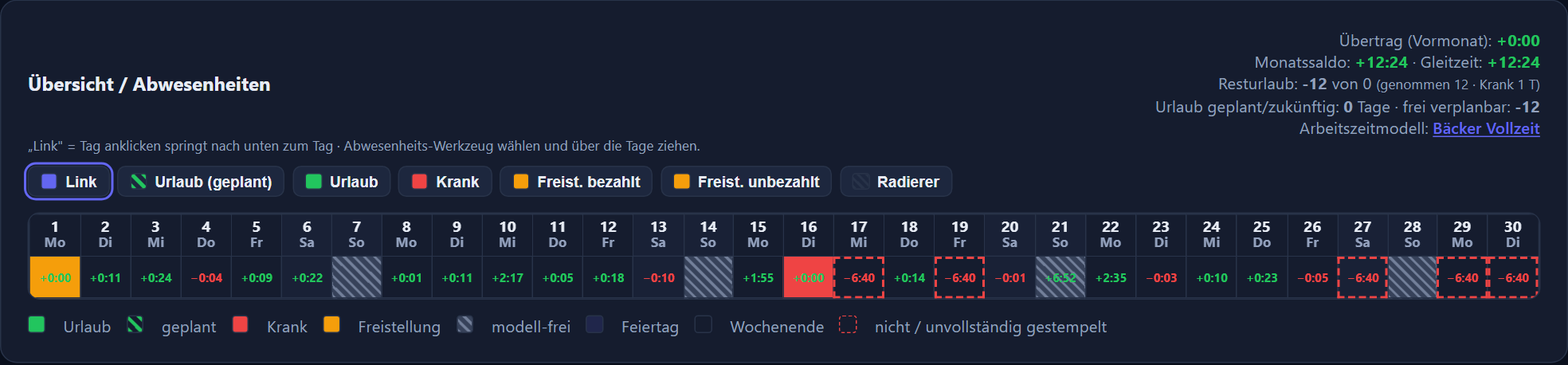
Start, end and duration per day, plus target, actual and balance — on one page, without anyone having to compile it first.
What this means for implementation
No particular product follows from the legal position. What does follow are requirements a solution can be measured against.
Complete, not selective
What gets recorded is the whole of the time worked, not only additional hours. A system that knows only overtime falls short.
Reliable and traceable
Records have to be demonstrable. Later entries and corrections should be documented with a reason, and deleted entries should remain traceable.
- corrections with a reason
- a recycle bin instead of deletion
- logging
Accessible to employees
People who can see their own hours and accounts spot mistakes early. That serves both sides and takes the monitoring character out of recording.
A fit for your own working time models
Flexitime, core hours, shifts, overnight work: if the system cannot represent your own rules, handiwork and mistakes follow — exactly what was supposed to be avoided.
How ITN-Zeiterfassung implements these points is set out in the feature reference — particularly in the chapters on the monthly view and on working time models.
Frequently asked questions about the recording duty
As an employer, do I have to record working hours?
In Germany, yes. In its ruling of 13 September 2022 (1 ABR 22/21) the Federal Labour Court held that § 3(2)(1) of the Occupational Safety and Health Act gives rise to a duty to introduce a system for recording the hours worked by employees. What has to be recorded is not only additional hours but the whole of the time worked. Position as at August 2026.
Does the recording have to be electronic?
Under the law as it currently stands, no. The Federal Labour Court requires a system but makes no stipulation as to form. An express duty to record electronically is part of the planned amendment to the Working Hours Act, which as at August 2026 is not in force. Anyone already recording electronically will have nothing to change if it arrives.
Is a paper timesheet enough?
Because the ruling is open as to form, paper is not ruled out as such. In practice the question is whether records kept that way are complete, reliable and demonstrable in a dispute — and who carries the effort of evaluating them, checking breaks and tracking absences. For a legal assessment of your own case, please consult your legal advisers.
What applies regardless of the Federal Labour Court ruling?
Two duties have existed for a long time and apply independently of it: § 16(2) of the Working Hours Act requires hours worked beyond the eight-hour working day to be recorded and the records kept for two years. § 17 of the Minimum Wage Act requires records of the start, end and duration of daily working time in certain sectors.
May I delegate the recording to my employees?
The Federal Labour Court assigned the duty to the employer. That does not rule out staff clocking themselves — but responsibility for a working system existing and being used stays with the employer. Clarify the details with your legal advisers.
More on this: data protection and the works council — which is about how it is arranged, where co-determination does apply. And working time models for how it works in practice.